
The serious aviation traveller carries something home from every significant journey that has nothing to do with the contents of their luggage. Not a memory — though those accumulate too. Not a photograph — though those are taken. Something more specific: an understanding of the aircraft that carried them, the route it flew, and the engineering that made the journey possible. Most travellers let that understanding dissipate at the gate. The aviation enthusiast preserves it — in the logbook notation they still keep out of habit, in the conversation they had with the crew on the flight deck, and in the scale replica of the aircraft that sits on their desk at home and marks the journey in permanent form.

Travel excellence is not simply about where you go and how comfortably you get there. For the aviation traveller, it is about engaging with the experience of flight — the aircraft, the route, the history of the service — with the same seriousness that a wine traveller brings to a vineyard visit or an architecture enthusiast brings to a new city. The journey is the destination as much as the destination is. And the objects that document that engagement are among the most considered additions to any home.
The Aircraft as Destination: Why the Most Interesting Part of the Journey Is Often the Machine
The traveller who boards a Boeing 747 and sees only a seat and a screen is missing the most engineered object they will encounter in their entire journey — possibly in their entire year. The 747’s upper deck hump, the sweep of the wing visible from a window seat over the trailing edge, the four engine nacelles hanging in formation below the wing: these are design decisions made by engineers responding to specific aerodynamic and structural requirements, producing a silhouette so distinctive that it has defined international travel for over fifty years. The aviation traveller who understands this boards a different aircraft from the one that the indifferent passenger boards — and arrives at a different destination, carrying more of the journey with them.
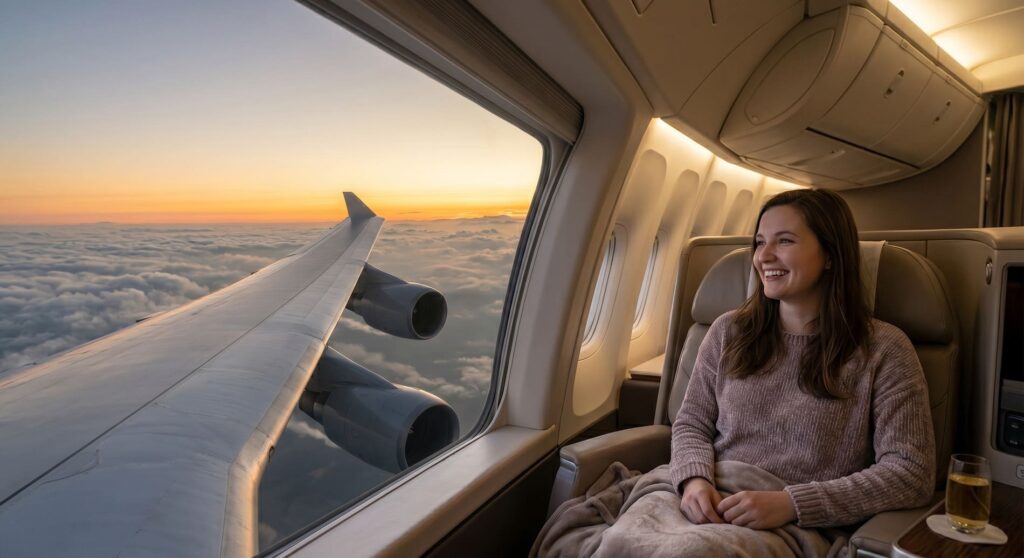
The Airbus A380 adds a further dimension: the double-deck fuselage that makes it the largest passenger aircraft in service, the four Rolls-Royce Trent 900 engines that power it across oceans, the quiet cabin that makes long-haul travel genuinely less wearing than any previous wide-body. The aviation traveller who flies a Singapore Airlines or Emirates A380 is not simply crossing an ocean. They are experiencing a specific engineering achievement — one that may not remain in production long enough for the next generation of travellers to know it in the same way.
What Aviation Travellers Bring Home — And Why Scale Models Outlast Everything Else
The question of what to bring home from a significant aviation journey is one that most travellers answer instinctively with photographs. Photographs are immediate, shareable, and entirely flat. They capture the visual surface of an experience without capturing its three-dimensional character — the physical presence of an aircraft at the gate, the relationship between the wing and the fuselage seen from a specific angle, the engineering logic that makes the machine comprehensible as an object rather than simply a vehicle. A precision airplane model of the aircraft that carried a traveller across a significant route does what the photograph cannot: it puts the aircraft in the room, in three dimensions, in correct proportions, where it can be examined from every angle and understood as the design object it is.
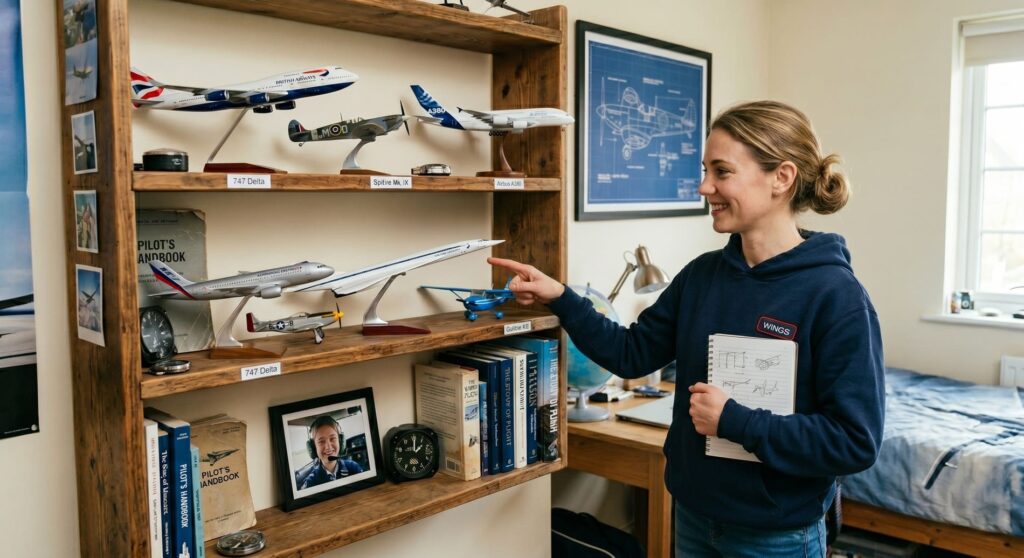
The aviation traveller who commissions a custom aircraft replica of a specific aircraft in the specific airline livery of a meaningful journey is not producing a souvenir. They are producing a documentary object — a record of an aircraft, a route, and a moment in aviation history that the passage of time will eventually make unrepeatable. The Singapore Airlines 747 on the Changi to Heathrow route is already history. The Emirates A380 may follow within a decade. The scale replica that documents these aircraft in their operational prime is not available at the airport shop. It has to be thought about, chosen, and commissioned — which is the appropriate level of engagement for an experience worth preserving.
The traveller who brings home a scale model of the aircraft that defined their journey is not collecting. They are documenting — with the same seriousness that any other form of travel excellence deserves.
The Ground Journey: How the Automotive Passion Connects to the Aviation One
The serious aviation traveller rarely arrives at the airport from an anonymous starting point. The drive to the terminal — whether in a personal vehicle, a hire car on a road trip that terminates at a departure gate, or the car that has carried them to airports across two decades of travel — is part of the journey as much as the flight itself. The aviation enthusiast who also has a relationship with automotive design and engineering is not unusual: the same attention to engineering logic, performance, and design intent that characterises engagement with aircraft applies equally naturally to cars. Commissioning a custom aircraft replica alongside a scale replica of the car that made those airport drives is not a change of subject. It is a continuation of the same collecting philosophy — applied to both machines that carried them, one through the sky and one across the ground.
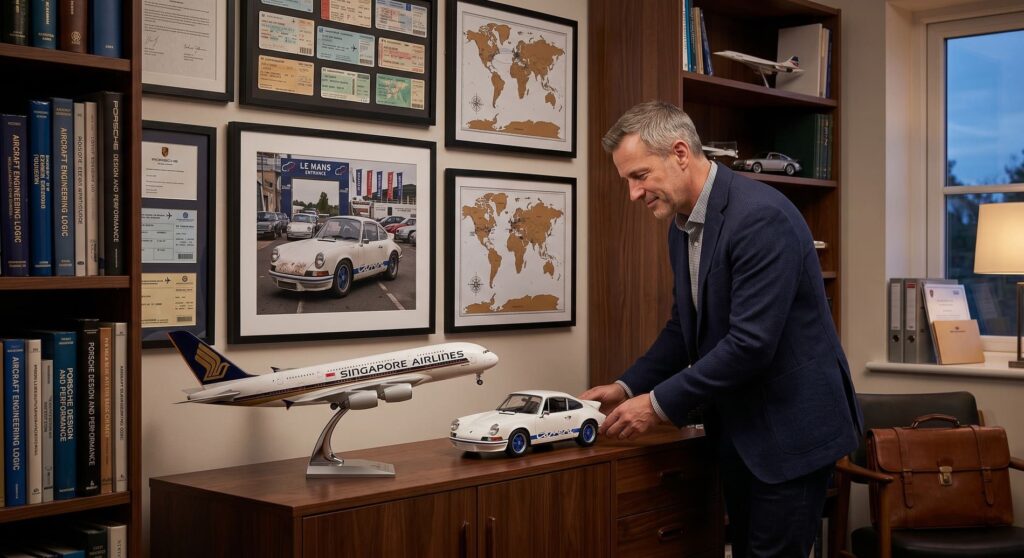
The traveller whose home displays a 1:200 Singapore Airlines A380 alongside a 1:18 model car of the Porsche they drove to Le Mans one summer is not mixing categories. They are displaying a coherent identity — someone for whom engineered machines, in any medium, command the same quality of attention and deserve the same quality of documentation. That coherence is what distinguishes a collection from an accumulation. And it is what the best aviation travellers bring home from every journey: not just the destination, but the evidence that the journey was worth taking seriously.
How to Choose a Scale Model That Documents a Journey Worth Remembering
The aviation traveller who wants to document a significant journey in scale has three considerations: the aircraft type, the airline livery, and the scale. The aircraft type should be the specific variant flown — a 747-400 and a 747-8 are different aircraft with different design histories, and the difference matters to anyone with genuine engagement with aviation. The airline livery should be period-accurate — the carrier’s current scheme if the journey was recent, the historical scheme if the journey being documented was made years ago and the livery has since changed. The scale should match the intended display context — 1:400 for a fleet display among other models, 1:200 for a single-aircraft desk piece, 1:144 for a statement display where the aircraft’s proportions need to read clearly at distance.
The traveller who thinks about these three choices has already engaged with the aircraft more seriously than most of their fellow passengers. The scale model that results from those choices will document the journey more accurately than any photograph — and will still be on the shelf, in correct proportion and period livery, twenty years after the flight log has been filed and the boarding pass has been lost.
Frequently Asked Questions
What scale airplane model is best for documenting a specific flight?
1:200 is the most practical scale for documenting a specific airline and aircraft type — producing a model of 350–480mm for most wide-body subjects that displays clearly on a desk or shelf without requiring dedicated display furniture. For collectors who want maximum livery accuracy and surface detail, 1:144 provides additional legibility at arm’s length. A commissioned custom aircraft replica in the exact livery variant of a specific journey — including period-accurate tail logo, cabin window configuration, and engine variant — is available at any scale through specialist commission.
Can I commission a model of the specific aircraft registration I flew on?
Yes. A commissioned airplane model can be produced to a specific aircraft’s registration, airline livery, and configuration — including the exact variant’s engine type, winglet configuration, and period-appropriate markings. For travellers wanting to document a specific route or historically significant flight, the tail registration and airline livery provide the foundation for an accurate commission. Reference photographs of the specific aircraft improve accuracy significantly.
Why do aviation enthusiasts also collect model cars?
The collecting logic that drives aviation scale model acquisition — precision, historical accuracy, engineering significance, personal connection to the subject — applies equally to automotive subjects. Many aviation enthusiasts are also serious automotive enthusiasts for precisely the same reasons: both fields reward the kind of attention that reveals design decisions beneath the surface. A model car chosen with the same criteria as a scale aircraft replica — specific subject, accurate specification, quality of execution — belongs in the same collection for the same reasons.
The Journey That Stays
The airport shop sells travel. The serious aviation traveller brings something home that the airport shop cannot supply: a genuine engagement with the aircraft, the route, and the engineering that made the journey possible — documented in a form that will still communicate that engagement accurately in thirty years. The scale model on the desk is not a reminder of a holiday. It is a record of a journey taken seriously — which is the only kind of journey, for the aviation traveller, worth taking at all.
Travel excellence begins before the gate and ends long after the landing. The objects that mark it are the evidence that it happened — and that it was worth the attention it received.