
You are on a window seat, staring at a perfect blue sky, when you spot it: a thin white line drawn slowly across the heavens by a tiny silver speck. Almost every traveller has looked up at one of those lines and wondered what it really is. Some of us have even looked down from a plane window and pictured the people on the ground gazing back at us.
Those lines are called contrails, short for condensation trails, and the story behind them is a lovely mix of everyday physics and weather. Here is how they form, why some vanish in a blink while others linger for hours, and what they might quietly tell you about the sky.
What Exactly Is a Contrail?
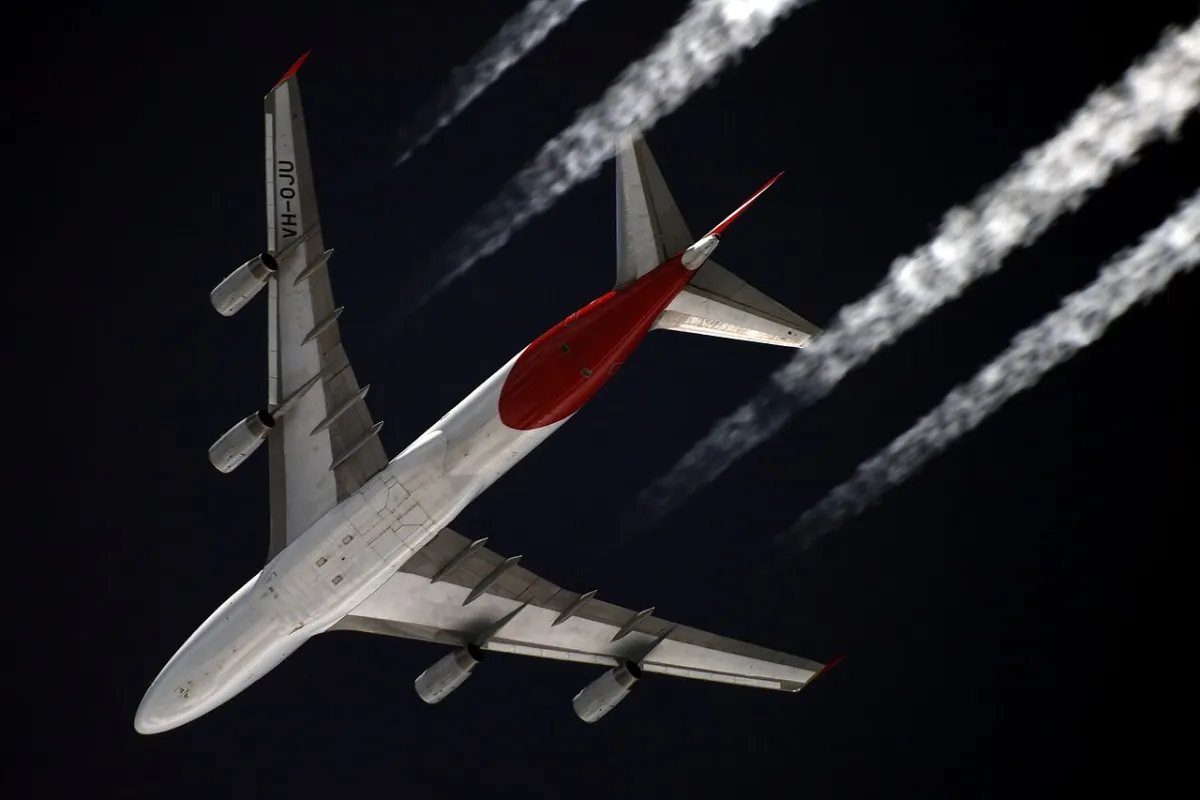
A contrail is a thin cloud made of ice crystals that forms behind an aircraft flying high in the sky. It is not smoke, and it is not a sign that something is wrong with the plane. In fact, it is a sign that the engines are doing exactly what they should at cruising height.
The Short Version
Jet engines burn fuel, and the exhaust is mostly carbon dioxide and water vapour. At cruising altitude the air outside is extremely cold. When the warm, moist exhaust mixes into that icy air, the water vapour cools rapidly and turns into tiny ice crystals. Those crystals catch the sunlight and show up as the white streak we see from the ground.
Like Your Breath on a Winter Morning
If you have ever breathed out on a freezing day and watched a little cloud appear, you already understand contrails. Your warm, damp breath meets cold air and becomes visible. A jet engine does the same thing, just on a much grander scale and several kilometres above the ground.
Why Do Some Planes Leave Trails While Others Do Not?
Have you noticed that two planes crossing the same patch of sky can behave differently, one trailing a bright line and the next leaving nothing at all? That is not your imagination, and the plane itself is rarely the reason. The air is.
It Is All About the Air at Cruising Height
Contrails need air that is both very cold and humid at the altitude where the aircraft is flying. If the air up there is too warm or too dry, the ice crystals do not form, or they melt away almost instantly. The FAA also points out that humidity on the ground tells you little about conditions high above, so a dry day below can still be a damp one at cruising height.
Tiny Particles Help Too
Water vapour likes to gather on something solid. Microscopic particles in the air, along with soot-like particles from the engines, give the vapour a surface to cling to before it freezes. That is part of why the trail appears just behind the aircraft rather than somewhere random in the sky.
Why Some Contrails Vanish and Others Last for Hours
Watch a contrail for a few minutes and you may see it fade away like a whispered secret. Others stretch from one horizon to the other and slowly widen into soft, hazy ribbons. Both are perfectly normal.
The Quick Fade
Most contrails disappear within seconds to minutes. When the surrounding air is dry, the ice crystals evaporate almost as quickly as they form. Short, thin trails are often described as a hint that the air high up is dry, which commonly goes with settled weather.
The Long Linger
When the upper air is very humid, the ice crystals have plenty of moisture to grow on, and the trail can last for hours. Winds high above the ground can then stretch and spread it. According to the FAA, a lingering contrail you see overhead may have been created by a flight that passed far away some time ago. Thick, long-lasting trails are sometimes taken as an early sign that the weather could change, although that is a rule of thumb rather than a guarantee.
From Contrail to Cirrus
Persistent contrails can spread out into thin, wispy cloud sheets sometimes called contrail cirrus. They can look almost identical to natural high clouds, which is why a sky that was crystal clear in the morning can look streaky by afternoon after a busy stretch of air traffic.
Do Contrails Matter for the Climate?
This is where the topic gets interesting, and honestly a little uncertain. The FAA treats persistent contrails and the cloudiness they create as part of aviation’s wider climate story, and researchers are actively studying how large the effect is. The source I relied on does not put a firm number on it, so it is best to say that scientists are still working to understand the full picture.
Could Flights Simply Avoid the Worst Spots?
Some of the ideas under study are quite practical. Cleaner engines and alternative fuels are on the list, and so is gently rerouting flights around the invisible pockets of very humid, ice-rich air where long-lived contrails tend to form. For passengers that could one day mean a slightly adjusted altitude or path, with no change to the comfort of the journey.
How to Spot Contrails Like a Pro on Your Next Flight
You do not need any special equipment, only curiosity. Next time you fly, try these small observations:
- Look out of the window at cruising height and see whether your own aircraft is leaving a trail behind it.
- Notice whether other planes in the distance are trailing lines, and how long those lines last.
- On the ground, time a contrail with your phone and see how quickly it fades.
It turns an ordinary journey into a tiny weather experiment, and it is wonderfully calming to watch the sky draw and erase its own lines.
Frequently Asked Questions
Are contrails the same as clouds?
They are very similar. A contrail is a cloud of ice crystals, but one made by an aircraft rather than by natural weather. Persistent ones can even blend into natural-looking cirrus.
Are contrails harmful to passengers?
No. A contrail forms outside the aircraft, in the air behind it, and it has no effect on the cabin or on the people inside it.
Why do I sometimes see no trail at all?
Usually because the air at that altitude is too warm or too dry for ice crystals to form or survive. The aircraft is working normally; the sky simply is not in the mood to show it off.
Final Thoughts
The next time a bright white line crosses the sky, remember what you are really looking at: warm exhaust meeting freezing air, turning into a fleeting river of ice. It is science, weather and flight all at once, painted across the blue for anyone who looks up. Whether it fades in seconds or stretches for hours, a contrail is a small reminder that every flight is a journey through a living, changing sky.