
When people in India talk about regional aviation, flybig is one of the names that comes up, mostly because of how deliberately it chose its territory. The airline was promoted by Big Charter Private Limited, a Gurugram-based company led by Captain Sanjay Mandavia, and it began flying on 21 December 2020. Instead of competing head-on with the big carriers over the busiest metro pairs, flybig went looking for places where a scheduled flight barely existed. Its focus was tier-2 and tier-3 towns, the sort of airports that had a runway and a terminal but very few departures. That decision shaped everything else: the aircraft it leased, the hubs it picked, the staffing it kept lean, and the government scheme it leaned on. Understanding flybig therefore means understanding a business model built around connectivity first and volume second, where each new route was an experiment in whether a small town could sustain regular air service.
The UDAN Scheme Behind the Wings
The backbone of the airline’s plan was UDAN, the Regional Connectivity Scheme through which the government supports flights to underserved airports. Under this arrangement, an operator wins a bundle of routes through bidding, often gets a period of exclusivity on them, and receives viability support so that low fares remain workable. For flybig, that meant it could open sectors that no one else had flown in years. Executives described being awarded around twenty routes in one UDAN round, with a handful in central India and the majority in the northeast. The logic was sound on paper: subsidised fares attract first-time flyers, exclusivity protects early traffic, and small aircraft keep trip costs manageable. The weakness of such a model is dependence. When a business leans this heavily on scheme payments, the timing of those payments becomes as important as ticket sales, and any delay in the cash cycle can ripple straight into lease rentals, fuel bills and salaries.
Hubs and Route Network
Geography played a large part in the network. The airline started with a base at Indore, which allowed it to touch central Indian towns such as Gondia, and then built a second hub at Guwahati to serve the northeast. From Guwahati, flights reached Agartala, Dibrugarh, Imphal, Kolkata, Tezu, Pasighat, Itanagar and other stations, many of them in hilly or remote districts where road journeys can stretch for a whole day. The northeast was a natural fit because surface travel there is slow and weather-dependent, so even a short flight saves an outsized amount of time. Beyond UDAN, flybig also worked with the Assam government under a viability funding arrangement to operate the Guwahati and Dibrugarh service, which counted as one of the first state-supported flights outside the central scheme. Such partnerships showed that regional carriers can find revenue in state cooperation as well.
flybig at a Glance
| Aspect | Detail |
|---|---|
| Promoter | Big Charter Private Limited |
| Headquarters | Gurugram, Haryana |
| First flight | 21 December 2020 |
| Main hubs | Indore and Guwahati |
| Core focus | Tier-2 and tier-3 connectivity |
| Aircraft | ATR 72 turboprops, with Twin Otter plans announced |
| Route sources | UDAN awards and state viability funding |
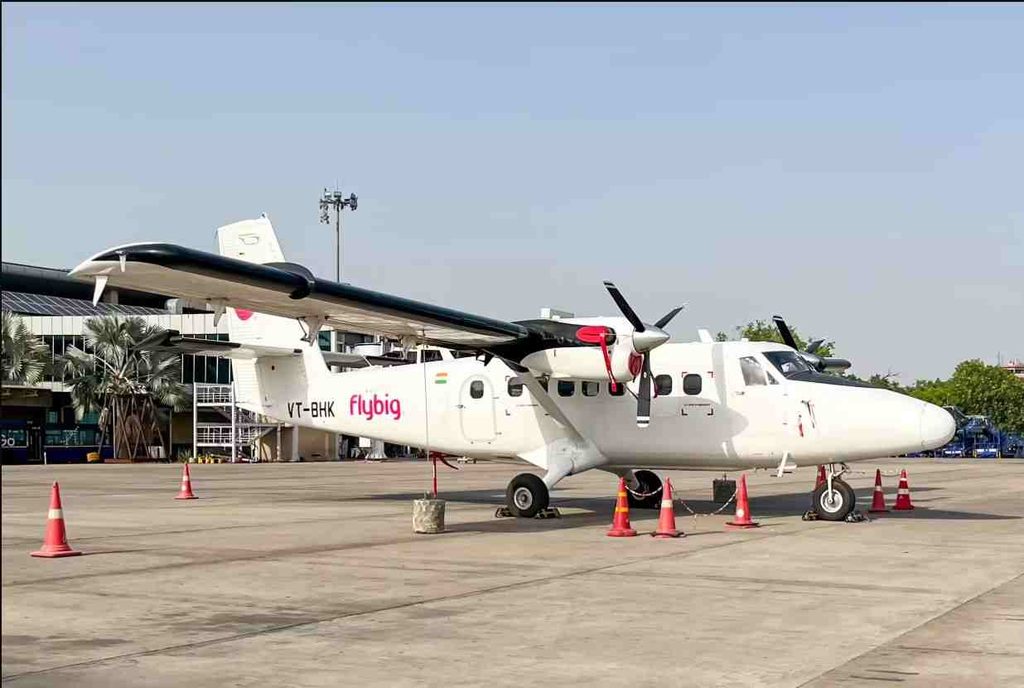
The fleet was small and practical. Most flying was done on ATR 72 turboprops, aircraft that suit short runways and thin routes because they burn less fuel per trip than jets and can still carry around seventy passengers. Public reports at various times listed roughly three to four aircraft, mostly leased from international lessors rather than owned. The airline also announced a letter of intent for up to ten De Havilland Canada Twin Otter Series 400 aircraft, a 19-seat type able to operate from land or water, which fit its plan for very small airfields. For flybig, leasing kept upfront costs down, but it also meant that a dispute with a lessor could ground the entire operation quickly. With so few aircraft, every technical delay or repossession carried heavy weight, and there was little spare capacity to cover gaps in the schedule.
What Passengers Experienced
From a traveller’s view, the appeal was simple: a direct flight where none had existed. A family in a small district town could reach a state capital in under two hours rather than spend a day on a highway. Students, patients, traders and government staff formed a good part of the demand, and tourists exploring Arunachal Pradesh, Manipur or Tripura found the hops convenient. The airline promoted a friendly, family-style cabin atmosphere and tried to keep timings convenient for same-day connections. Fares under UDAN were capped, which encouraged first-time flyers who had previously treated air travel as out of reach. Naturally, small-town aviation has its quirks. Frequencies were limited, sometimes only a few days a week, and weather in hilly terrain could cancel departures at short notice. Passengers who understood those trade-offs often valued flybig for what it offered rather than judging it against full-service metropolitan airlines.
Strengths That Stood Out
Looking back, several strengths are worth noting. They explain why the idea attracted attention even among seasoned aviation watchers, and why other operators continue to bid for similar routes.
- Route selection: it targeted sectors with no competing scheduled service.
- Lean structure: small teams per aircraft and turboprop economics kept operating costs modest.
- Local partnerships: cooperation with state governments broadened its revenue options.
- Social impact: faster access to healthcare, education and markets for remote communities.
Where Things Went Wrong
Ambition met hard financial reality in 2023. According to industry reporting, lessors repossessed the two ATR 72 aircraft placed with the airline in November 2023, and flights were suspended. One lessor alleged that UDAN funds paid into a designated escrow account had been moved improperly, a claim the airline’s chairman rejected, describing it as part of a conspiracy against competition in the scheme. Whatever the final legal outcome, the episode exposed a structural risk. A carrier operating leased aircraft on subsidised routes lives on a narrow cash margin, and once trust with lessors and banks breaks, the schedule cannot survive for long. The chairman said at the time that flybig was talking to other lessors and suppliers about acquiring aircraft, but available reports did not confirm a full return to service. Anyone planning travel should verify the airline’s present status through official channels before making any commitment.
Lessons for India’s Regional Aviation
The story of flybig is useful even for people who never boarded one of its flights. First, regional aviation cannot rest on subsidy alone; schemes help, but disciplined cash management must sit beside them. Second, ownership or long-term stable leasing matters, because aircraft are the most visible and most fragile asset in a small airline. Third, escrow and payment mechanisms need transparent oversight so that every stakeholder can see where money moves. Fourth, route development takes years, not months; a town that has never had air service needs time to build the habit of flying. Finally, state and central agencies can help by pairing viability support with performance checks, ensuring that operators are stable enough to keep promises to communities. When these pieces line up, small-city flying can work, as several regional operators elsewhere in the world have shown.
How flybig Compares With Larger Carriers
Larger airlines treat regional routes as one part of a broad network, feeding passengers into metro hubs and spreading risk across many sectors. flybig did the opposite: it made the regional segment its entire identity. That gave it clarity of purpose and a strong story with local governments, but it also removed any cushion. A big carrier can absorb a weak route by leaning on profitable trunk lines; a specialised operator cannot. In practice, flybig behaved more like a public-service venture with a commercial licence than like a conventional airline chasing yield. Its schedule reflected local needs, its pricing reflected caps, and its growth reflected government bidding rounds. This is neither good nor bad by itself, yet it explains why the airline’s fortunes moved so closely with scheme timing, funding flows and partner confidence, more than with seasonal demand alone.
Advice for Travellers and Researchers
If you are researching flybig for travel or study, start by separating history from current operations. The company’s launch, its UDAN awards and its northeast expansion are well documented, while its present schedule may differ from earlier timetables. Look for the latest statements from the aviation regulator and the airline itself, and never assume a route shown in an old listing is still running. Students of aviation policy will find the flybig case valuable as a compact example of how subsidy design, leasing and escrow controls interact. Business writers can study its branding around family warmth and local pride. Travel bloggers might trace the towns it connected and record how residents describe the change. Whatever your angle, treat flybig as a case study in ambition and fragility rather than a simple success or failure story.
Conclusion
The airline’s journey shows both the promise and the peril of small-town aviation. It found real demand in places that mainstream carriers overlooked, connected districts across central and northeast India, and proved that a lean turboprop operation can win public goodwill. It also showed how quickly a tightly funded model can unravel when aircraft leases, subsidy payments and banking arrangements fall out of step. For policymakers, the message is to design support that rewards stability. For operators, it is to hold reserves and protect relationships with lessors. For travellers, it is to check current schedules before planning. Regional connectivity remains a worthwhile national goal, and the lessons left by this airline can help the next generation of carriers fly longer, safer and more reliably to the towns that need them most.