
Indian aviation has seen plenty of churn over the past decade, but few carriers have reinvented themselves as decisively as Air India Express. Once a modest regional operator built to serve expatriate workers flying between Kerala and the Gulf, it has grown into one of the country’s most closely watched low-cost airlines. Under Tata Group ownership, the carrier has expanded its domestic footprint, absorbed a sister airline, and pushed into new international corridors that were previously out of reach. For travelers weighing budget options against full-service carriers, understanding how Air India Express operates today, where it flies, and what it offers on board can make trip planning considerably easier.
A Brief History Worth Knowing
Air India Express began operations in 2005 as a subsidiary built specifically to serve the heavy demand for affordable travel between southern India and West Asia. For years, its identity stayed narrow, mostly shuttling migrant workers and their families between Kerala, Karnataka, and Gulf cities. That changed dramatically after Tata Sons reacquired Air India in 2022. As part of a broader restructuring, Tata merged its low-cost brand AIX Connect into Air India Express, consolidating two overlapping operations into a single, larger budget carrier. This merger gave the airline a bigger fleet, a wider domestic network, and a renewed mandate to compete directly with other Indian low-cost operators rather than sticking to its old regional niche.
The result is an airline that looks quite different from what it was even five years ago. Air India Express now positions itself as the value arm of the larger Air India Group, working in tandem with the full-service Air India brand while targeting price-sensitive leisure and family travelers. This dual-brand strategy mirrors what many global aviation groups have done, running a premium carrier and a budget carrier under one corporate umbrella to capture different customer segments without cannibalizing either.
Network Expansion Through 2026
One of the clearest signals of the airline’s growth is its route map. Air India Express has been adding destinations at a steady clip throughout 2026, with a particularly notable expansion planned for September that brings six new domestic stations into the network, including Aurangabad, Coimbatore, Jamnagar, Jodhpur, Madurai, and Tirupati. These additions push the total network toward roughly five dozen destinations, split between domestic Indian cities and international points, mostly concentrated in the Gulf and Southeast Asia.
The airline has also been increasing frequencies on established routes rather than only chasing new cities. Delhi’s connections to Bhubaneswar, Kochi, Patna, and Varanasi have all seen additional daily flights, reflecting demand growth on routes that link the capital with business, pilgrimage, and cultural hubs. This pattern suggests Air India Express is trying to deepen its presence in markets it already understands rather than spreading itself too thin chasing every new city on the map.
Internationally, the Gulf remains the backbone of the airline’s overseas operations. Kerala cities like Kochi, Kannur, Kozhikode, and Thiruvananthapuram continue to anchor flights to Muscat, Dubai, Sharjah, Abu Dhabi, Doha, and other Gulf hubs. Air India Express has also become the first Indian carrier to connect Northeast India directly with Gulf destinations, a route category that previously required connections through larger metro airports.
Fleet and Onboard Experience
Air India Express operates a fleet built primarily around Boeing 737 aircraft, a workhorse narrow-body well suited to both short domestic hops and medium-haul international routes to the Middle East and Southeast Asia. Since the merger with AIX Connect, the fleet has also incorporated Airbus A320 family jets, giving the airline more flexibility across different route lengths and passenger loads.
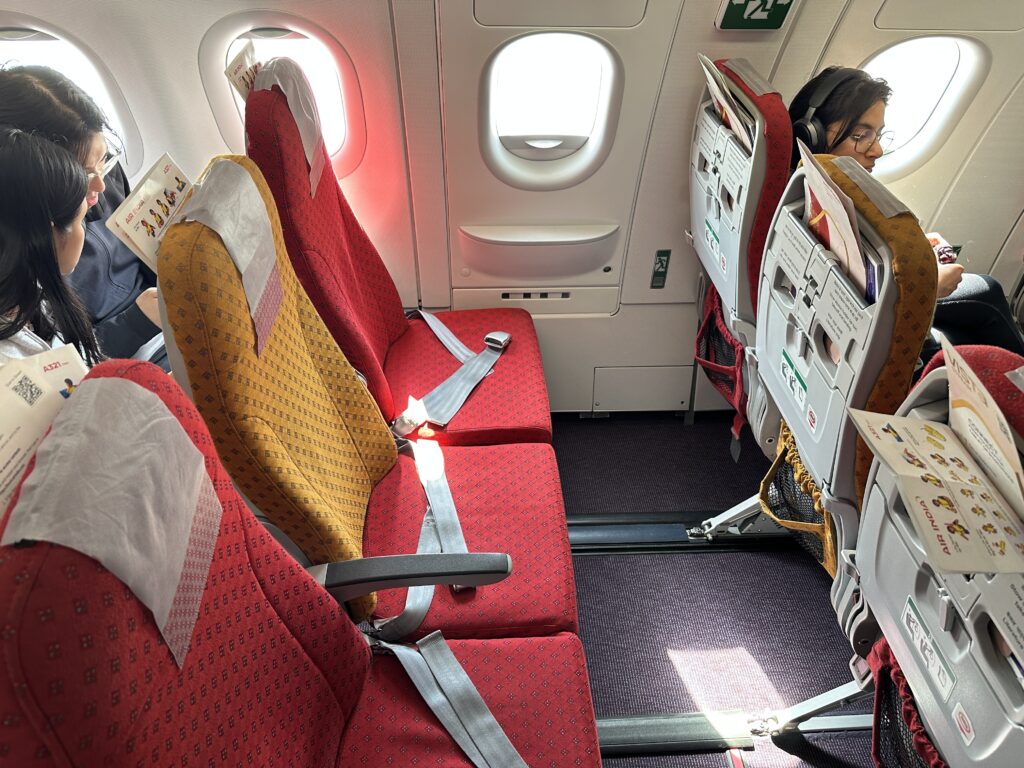
As a low-cost carrier, Air India Express keeps its onboard offering fairly straightforward. Meals and most extras are available for purchase rather than included by default, and seating follows a single economy-class configuration designed to maximize capacity. That said, the airline has worked to differentiate itself from ultra-budget competitors by offering:
- Assigned seating with optional upgrades to extra-legroom rows
- Checked baggage allowances bundled into most standard fares
- A loyalty program shared with parent carrier Air India, letting frequent flyers earn and redeem points across both airlines
- Digital self-service tools, including an AI-powered virtual assistant for rebooking and customer support through messaging platforms
This blend of no-frills pricing with a few service touches has helped the airline appeal to travelers who want savings without feeling like they are flying a bare-bones operation.
Booking Trends and Fare Behavior
Fare patterns on Air India Express routes tend to follow predictable logic once you understand how competition shapes pricing. Newly launched routes typically carry lower introductory fares because demand hasn’t caught up with supply yet, while established, heavily trafficked corridors often see steadier or higher pricing due to consistent booking volumes. Travelers eyeing a newly opened Gulf or domestic route may find better deals in the early months after launch than once the route matures.
Comparing fares across similar-distance routes also reveals interesting gaps. Two flights of nearly identical length can carry very different price tags depending on how much competing capacity exists on that specific corridor. A route with several airlines fighting for the same passengers will usually be cheaper than a route where one carrier holds a near-monopoly, even if the flying time is almost the same. This is a useful principle for budget-conscious travelers to keep in mind rather than assuming price scales purely with distance.
Air India Express vs Full-Service Carrier: Key Differences
| Factor | Air India Express | Full-Service Carrier |
|---|---|---|
| Base fare | Generally lower | Generally higher |
| Meals | Paid add-on | Often included |
| Baggage allowance | Included, but limited | Typically more generous |
| Seat selection | Paid or basic free option | Often included |
| Route focus | Domestic + Gulf/Southeast Asia | Broader global network |
| Loyalty program | Shared with Air India | Standalone or shared |
How It Fits Into the Tata Aviation Strategy
Understanding Air India Express also means understanding its place within the larger Tata aviation puzzle. Tata Group now controls a spectrum of airlines in India, ranging from the premium-positioned Air India and Vistara merger at the top, down to Air India Express at the value end, with domestic low-cost carrier AirAsia India having also been folded into the group’s restructuring. This layered approach allows Tata to capture customers across every price point, from business travelers booking full-service international flights to budget-conscious families planning a domestic getaway.
Air India Express plays a specific role in this structure: it handles the price-sensitive, high-frequency routes that wouldn’t make financial sense for a full-service carrier to operate profitably, while still benefiting from shared infrastructure, booking systems, and loyalty programs with its larger sibling. This shared backbone is part of why the airline has been able to expand its network so quickly without building every system from scratch.
Operational Disruptions and Contingency Handling
Like any airline flying through geopolitically sensitive airspace, Air India Express has occasionally had to adjust schedules due to regional tensions affecting flight paths over West Asia. During periods when certain airspaces have faced restrictions, the airline has worked alongside Air India to maintain core scheduled services to unaffected destinations like Jeddah and Muscat, while also running additional non-scheduled flights to help travelers who were stranded elsewhere in the region get home. Passengers affected by such disruptions are typically offered free rebooking or full refunds rather than being left to absorb the cost themselves.
This kind of contingency planning matters for travelers evaluating any airline, not just Air India Express. Flights can occasionally be cancelled for operational or safety reasons unrelated to the carrier’s performance, and how an airline handles rebooking, refunds, and communication during those moments says a lot about its overall reliability. Air India Express has generally leaned on digital tools, including WhatsApp-based support, to keep affected passengers informed and moving.
What Travelers Should Watch For
Anyone considering Air India Express for an upcoming trip should keep a few practical points in mind before booking:
- Confirm whether a route is newly launched, since early fares may not last
- Check baggage policies carefully, as allowances can vary by route type
- Compare total trip cost, not just base fare, when weighing options against full-service carriers
- Watch for schedule changes on Gulf routes during periods of regional airspace disruption
None of these considerations are unique to this airline, but they matter more on a low-cost carrier where fare rules and service inclusions tend to be less generous by default than on a premium airline.
Conclusion
Air India Express has clearly moved past its origins as a niche regional carrier serving Gulf-bound Keralite workers. Backed by Tata Group’s broader aviation strategy, it has grown into a genuine value-focused competitor with an expanding domestic footprint, a growing Gulf and Southeast Asia network, and a fleet capable of supporting that ambition. For travelers, this evolution translates into more route choices, generally competitive pricing, and a loyalty program that connects usefully with its full-service sibling. Whether Air India Express continues this rapid expansion at the same pace remains to be seen, but its trajectory over the past few years suggests it intends to remain one of the more significant players shaping how budget-conscious Indians and Gulf travelers choose to fly.