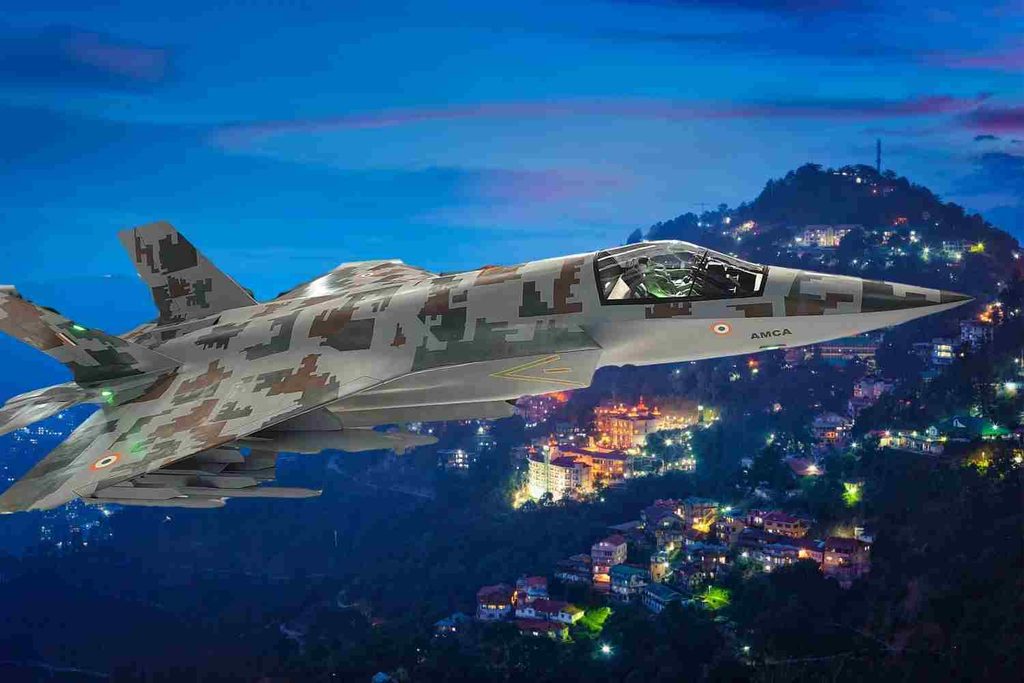
The advanced medium combat aircraft represents one of the most ambitious defense projects undertaken in recent years, aimed at giving air forces a domestically developed, fifth-generation stealth fighter capable of matching global rivals. Unlike earlier fighter jets that relied heavily on foreign collaboration, this program is being designed and engineered largely through indigenous efforts, marking a shift toward self-reliance in aerospace technology. The aircraft is envisioned as a twin-engine, single-seat platform built for versatility, combining stealth characteristics with high maneuverability and advanced sensor fusion.
What makes this initiative particularly significant is its scope. It is not merely an upgrade of existing fighters but a ground-up design intended to compete with the world’s most sophisticated combat jets. Engineers and defense planners have prioritized low radar cross-section, internal weapons carriage, and next-generation avionics, all while keeping long-term operational costs manageable. As geopolitical tensions rise across various regions, the urgency behind developing such a platform has only intensified, pushing research institutions and private defense contractors to accelerate timelines.
Why Stealth Capability Matters So Much
Modern aerial warfare has shifted dramatically toward detection avoidance, and this is where the advanced medium combat aircraft distinguishes itself from older fourth-generation jets. Radar-evading design elements, including angular fuselage shaping and radar-absorbent coatings, allow the aircraft to penetrate contested airspace with reduced risk of early detection. This capability changes the nature of engagement, giving pilots the advantage of striking first while remaining harder to track.
Stealth is not just about shape; it also involves managing heat signatures, minimizing electromagnetic emissions, and integrating weapons internally rather than on external hardpoints. Every one of these factors contributes to survivability in contested zones where enemy radar and missile systems are increasingly sophisticated. Defense analysts often point out that stealth alone does not guarantee dominance, but when combined with superior sensors and networked combat systems, it becomes a decisive force multiplier. This is precisely the philosophy guiding the development of this next-generation fighter platform.
Key Design Features That Set It Apart
Several design choices distinguish the advanced medium combat aircraft from conventional fighters currently in service. The twin-engine configuration provides redundancy and greater thrust, essential for maintaining performance during high-stress combat maneuvers. Internal weapons bays reduce drag and radar signature simultaneously, while advanced composite materials lower overall airframe weight without compromising structural strength.
Some of the standout features include:
- A diamond-shaped fuselage designed to deflect radar waves efficiently
- Internal fuel and weapons storage to preserve stealth profile
- Advanced sensor fusion combining radar, infrared, and electronic warfare data
- Supercruise capability allowing sustained supersonic flight without afterburners
- A highly digitized cockpit with reduced pilot workload through automation
These elements are not isolated additions but part of an integrated design philosophy where every component supports the aircraft’s core mission: surviving and dominating contested airspace. Unlike legacy platforms that were retrofitted with stealth features later in their service life, this fighter was conceived with these priorities embedded from the earliest design stages, which naturally results in a more coherent and efficient overall system.
Engine Development and Propulsion Challenges
Propulsion remains one of the most technically demanding aspects of building an advanced medium combat aircraft. High-thrust engines capable of supporting supercruise, agility, and stealth simultaneously require years of research, testing, and refinement. Engine development often becomes the bottleneck in fighter jet programs worldwide, and this project is no exception, with planners considering both indigenous engine development and interim collaboration with established foreign manufacturers.
The propulsion system must balance competing demands: enough power for high-speed intercept missions, fuel efficiency for extended range, and reduced thermal signature to avoid infrared detection. Achieving all three simultaneously is genuinely difficult, which is why many nations pursuing fifth-generation fighters have faced delays specifically tied to engine readiness. Some approaches involve using an existing engine variant for initial prototypes while a more powerful, indigenously developed engine is finalized for later production models. This phased strategy allows testing and pilot training to proceed without waiting for every subsystem to reach full maturity, though it does introduce complexity in long-term fleet standardization.
Avionics and Sensor Integration
Beyond stealth and propulsion, the sensor suite onboard an advanced medium combat aircraft plays a decisive role in combat effectiveness. Active electronically scanned array radar systems allow pilots to detect and track multiple targets simultaneously while resisting jamming attempts. Combined with infrared search and track systems, the aircraft can identify threats even when adversaries attempt to reduce their own radar signature.
Sensor fusion technology merges data from multiple sources into a single, coherent picture displayed to the pilot, drastically reducing cognitive workload during high-pressure situations. This integration allows for faster decision-making, which often determines outcomes in modern aerial engagements. Additionally, many of these platforms are being designed with network-centric warfare in mind, meaning they can share real-time data with other aircraft, ground stations, and naval assets. This interconnected approach transforms individual fighters into nodes within a broader combat network, amplifying their effectiveness well beyond what standalone capability could achieve.
Comparing Generations: A Quick Overview
To understand why this program matters, it helps to compare fighter generations side by side.
| Feature | Fourth-Generation Fighters | Advanced Medium Combat Aircraft |
|---|---|---|
| Radar Signature | Moderate to high | Significantly reduced |
| Weapons Storage | External hardpoints | Internal weapons bay |
| Avionics | Analog and semi-digital | Fully digital, sensor-fused |
| Engine Performance | Standard afterburner use | Supercruise capable |
| Networking | Limited data sharing | Real-time networked combat |
| Maintenance Complexity | Comparatively lower | Higher, due to advanced systems |
This comparison highlights why transitioning to fifth-generation platforms is not simply an incremental upgrade but a fundamental shift in how air combat is conducted. While maintenance and cost complexity increase, the tactical advantages gained often justify the investment for nations seeking long-term air superiority.
Strategic and Economic Implications
Developing an advanced medium combat aircraft carries implications far beyond the battlefield. Economically, such programs stimulate domestic aerospace industries, create specialized manufacturing jobs, and encourage growth in materials science, electronics, and software engineering sectors. Countries investing in indigenous fighter development often see ripple effects across civilian aviation and technology sectors as well, since many innovations developed for military use eventually find commercial applications.
Strategically, possessing a domestically produced stealth fighter reduces dependency on foreign suppliers for critical defense hardware, which can be a vulnerability during periods of political tension or export restrictions. It also enhances a nation’s bargaining position in international defense partnerships, since demonstrated capability often opens doors to co-development opportunities with other countries. However, these benefits come with substantial financial commitments, as research, testing, and production costs for fifth-generation fighters routinely run into billions of dollars over multi-decade timelines, requiring sustained political and budgetary support to see the program through to operational deployment.
Challenges Facing Development Timelines
No major fighter jet program proceeds without obstacles, and the advanced medium combat aircraft initiative faces several well-documented challenges. Technology transfer restrictions, budget allocation disputes, and the sheer complexity of integrating stealth, propulsion, and avionics systems simultaneously all contribute to extended development timelines. Prototype testing phases often reveal unforeseen issues that require redesign, further pushing back projected induction dates.
Common challenges include:
- Securing reliable indigenous engine technology
- Managing costs across a multi-decade development cycle
- Coordinating between defense research agencies and private manufacturers
- Ensuring supply chain resilience for specialized materials and components
- Balancing export control regulations with international collaboration needs
Despite these hurdles, historical precedent from other nations’ fifth-generation fighter programs suggests that persistence eventually pays off, even if initial timelines prove overly optimistic. Patience, sustained funding, and realistic milestone setting tend to be the deciding factors between programs that succeed and those that stall indefinitely.
The Road Ahead for Next-Generation Air Power
Looking forward, the trajectory of the advanced medium combat aircraft program will likely influence regional airpower balances for decades to come. As prototypes move toward flight testing and eventual serial production, attention will increasingly turn toward pilot training programs, maintenance infrastructure, and integration with existing fourth-generation fleets during the transition period. Mixed fleets combining older and newer aircraft are common during such transitions, requiring careful logistical planning to ensure operational readiness is maintained throughout.
Future iterations may also explore unmanned teaming capabilities, where the manned fighter coordinates with autonomous drones to expand situational awareness and strike options without increasing pilot risk. This concept, often called loyal wingman technology, is gaining traction globally and could become a defining feature of how this aircraft operates in future conflict scenarios. As the program matures, continuous upgrades to software, sensors, and weapons compatibility will likely extend its operational relevance well beyond initial induction, following the pattern seen in most modern fighter jet lifecycles.
Conclusion
The advanced medium combat aircraft program stands as a defining example of how modern air forces are reshaping their combat capabilities for an increasingly contested and technologically driven battlefield. From stealth design and sensor fusion to propulsion challenges and strategic economic benefits, every aspect of this initiative reflects the complexity involved in building a truly next-generation fighter jet. While technical and financial hurdles remain, the long-term payoff, both in terms of national security and industrial growth, makes this pursuit worthwhile for nations committed to seeing it through. As development progresses toward flight testing and eventual deployment, the world will be watching closely to see how this platform performs and what it signals for the future of aerial combat.